Wednesday, October 21, 2009

Wikipedia

The article that I chose to analyze in my blog is Intelligent Design. I thought that it would be pretty interesting because any sort of crazy religious topic is usually highly debated. It turns out that I was correct. A+ for me.

The discussion over this topic is a war zone. People are going back and fourth debating the feasability of this theory and its applications, if any, to science. However, once user summed up my analysis best by saying "I came to this page looking for information on Intelligent Design. What I found instead was a (in many ways well-written) critique of intelligent design. The article seems to be falling over itself to punch holes in the theory/philosophical stance/call it what you will." Though I do not agree with the theory of intelligent design, I find it completely bias that MOST of the article is dedicated to denouncing the theory.

I expect a definition and an account of its history. Not accusations that it is not science.

Thursday, October 15, 2009

Twitter

This article , written by Eric Qualman, has two focuses: the effectiveness of twitter and its inevitable downfall. For each focus Qualman lists several valid points. My favorite line in the article is "Twitter is free. If a local plumber has 1,500 followers, even if it's likely most of them aren't listening at any given moment, as long as at least one person is, that's all that matters." This shows that twitter basically follows the same principals as email spam, but on a followers only basis.

this article
Now for a quick commercial break that is completely wrong and about twitter.


Monday, October 5, 2009

Music Copyright and the internets

First, just to start out my blog on a light note, here is a parody of the anti-piracy commercial that is the beginning of a lot of films. It is making fun of the fact that if this film had been pirated, then this message wouldn't be there. It is accusing the film industry of punishing people that actually payed to see the film.


This next video is the one that I will be basing my argument on. It basically says that there needs to be a line drawn on what copyright violations are damaging and which ones are helpful.


I agree with the statements of the both of the speakers. I believe that the law should still stand firmly against those who steal copyrighted work and then turn around and sell it for a profit. Personal use of copyrighted material and remixes of the original work, however, should be considered a public good.

To make all creative properties public goods would solve most of the major problems facing media industries today, but the only way for this to ever happen is by installing a new tax. Money from this tax would be divided amongst artists based on the number of "plays" or "downloads". The government could keep track of this by inserting a "DRM" like script into the code of the file. This script would act like a digital rfid chip and track the number of downloads. The pool of money collected by the tax could then be divided accordingly.

There you have it, the cure for the cancer that the internet has been for the Media Industry.

.. your welcome.

Tuesday, September 29, 2009

On Music and The Internet

Throughout the 20th century record labels underwent many changes, trials and tribulations. However, during those same years they exploited artists, practiced greedy business, and limited music in the market by eliminating or absorbing their competition. Now, with the dawn of the digital era and with high speed internet acting as the instrument of piracy, the record companies will be annihilated; from the ashes will be born a new system that embraces technology, justly compensates and creates equal opportunities among artists and that is regulated to make music a public commodity that is open source and an inspires creativity.

In 1877 Thomas Edison, with inspiration from “…work on two other inventions, the telegraph and the telephone”, invented the cylinder phonograph. Little did he know, for his phonograph could only hold several minutes of recording and wasn’t particularly intended for song, that his invention would spawn the multi-billion dollar record industry. Edison’s invention was soon updated to a disc format and from there evolved in capacity, sound quality and durability. Initially there were three major labels: Victor, Edison and Columbia. Soon after the expiration of Edison’s patent on recording technology, new independent labels began releasing recordings; they mostly focused on jazz and blues. The first big challenge that the record companies faced came in the 1920’s, when radio stations began playing records over the airwaves and gave no compensation to the writer or copyright owner. This problem was solved by having Congress and the FCC intercede and create new legislation that regulated the radio stations by forcing them to keep tabs on how many times a song was played and pay the writer and copyright owner accordingly. The next trial that the record company faced was of a completely different sort but was handled in a similar fashion. In the 1940’s, after WWII, the reel to reel was brought over to the United States. This machine was expensive, but it became the first personal tool for music piracy. The machine could be used to record records in an analog format. The recordings had very low quality, were rarely sold second hand, and were contained to teenagers; even so the record companies managed to get the government involved by having the FCC collect a dividend from all blank media. This was the last true victory for the record industry.

Over the extensive lifetime of the record business, the companies have learned many trade secrets and ,like any good capitalist enterprise, they learned how to maximize profit. Normally this would be acceptable; a business doing all it can to make money just seems like common sense. However, this method is unethical when applied to an industry where art, individuality, and culture are affected on a grand scale. The truth is that the record companies control all aspects of the music that most people are aware of. It is widely known throughout the record industry that “All in all, the deal offered to artists by a major label is, you get the glory and we get the money”. The labels have vastly superior business and legal knowledge when cutting deals, and often artists feel pressured to sign these bad deals because of the desperation that come from working in such a competitive field. Once the artist signs, unless they are already extremely well established, they give record labels complete control of their art. During the recording process if “…the record company considers any master recording by the artist to be below its level of acceptability, the record company would typically demand the right to require that the artist rerecord such musical composition until the composition reaches the level that the company considers satisfactory for commercial distribution” and they often use this power to change the song until it conforms to a profitable cookie cutter mold. This standardization of music has become more and more evident as the major labels have merged; now only four major labels remain: Warner, EMI, Sony and Universal. The record industry is now technically an oligopoly because “…[four] record companies currently produce 83% of the recorded music currently sold in the United States.”. Also the song writers usually are not even entitled to the writes of their music because “The record company would typically insist on retaining as its property, free from any claims or action from the artist and the artists heirs…master recordings…as well as all the performances embodies on those recordings.”.


Sunday, September 27, 2009

The Net

Below is my expanded segment on Net Neutrality


Thursday, September 24, 2009

On Net Neutrality


The opposing argument: The internet must be regulated and in a free market environment. The only way to do this is to give the telecom companies control of the lines that they invested in. People usually only go to a few websites anyways, and most of the internet is filled with garbage and lies. Allow the telecom companies to regulate the internet and turn it into a viable market for all. With their guidance, piracy of all types would be greatly reduced, saving the newspapers, the radio, the music industry and the film industry all in one fell swoop.

Why it is wrong:
Starting off let me just say, the net should always be neutral. If I have any say, and I dont, corporations need to keep their greedy hands off of the internet and while there at it they can spend that spare time installing my damn fiber-optic lines. In this blog I will argue for the valiant efforts of net neutrality and DESTROY the arguments created by the tele-com companies.

To argue FOR net neutrality I must first clarify the definition that I will be following whilst addressing the issue. According to Wikipedia, which by the way could not exist without net neutrality, " A neutral broadband network is one that is free of restrictions on content, sites, or platforms, on the kinds of equipment that may be attached, and on the modes of communication allowed, as well as one where communication is not unreasonably degraded by other communication streams." What this basically means, is that a neutral network is a complex and unlimited network where more connections increases its efficiency. Right now there is a lot of junk on the internet because anyone can put anything on the internet, but internet filters are becoming continuously better by tracking user traffic. In this way, popular content is filtered in a sense by the general population because through the number of page views, more popular websites will make their way to the top of the Google search list.

Now comes my major argument ..... Ahem

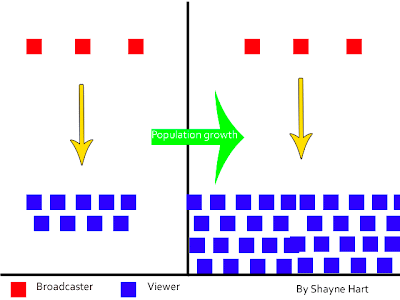
For the past few day I have been contemplating the benefits of net neutrality in comparison to a more controlled form of internet. At first I must admit I was finding more benefits for a more capitalized and controlled internet, but then I had a revelation. The global population is growing at a rate of approximative 77 million per year. If the network providers had the ability to regulate the internet it would evolve in the way illustrated in Diagram A. This would mean that the powerful would only become more powerful, gaining more and more viewers as the population grows. This is bad because as the population become bigger so does the talent pool, so it would become increasingly difficult for talented people to make it into the public sphere. Take for example music. It is inevitable that there will be more and more artists as the world population increases. However, it is much cheaper for the record labels to push a few big names in to the public sphere, and as population increases the number of "stars" can stay the same and just grow a larger fan base.

Diagram A: 1 way broadcast


Right now the internet is in an immature state, but as web 2.0 has shown, it is growing rapidly. When a neutral web becomes mature, however, it will be mind blowing and world changing. With net neutrality the internet is a many to many network as illustrated in Diagram B.


Tuesday, September 22, 2009

Democralypse Now!

The internet and democracy. The two should seemingly go together well enough, but as can be seen in online forums and youtube comments, the internet does not always reflect rational thinking. Come with me as I travel down the "series of tubes" that is the internet, and attempt to excavate any semblance of democracy.

Anonymity is a plus when it comes to voting, and the internet lends itself to creating a veil of privacy. Many websites successfully implement voting or rating such as youtube and digg, and the anonymity lends itself to improving content. Politicaly, the internet is a powerful tool as it provides a great source for aquiring information and increases the possibility of making an informed decision. Surpisingly enough, microsoft argues this point in this article. Also, the internet is a great tool for politians to connect with their constituents and find out thier opinions on upcoming policies and decisions.